
Seven new Academy articles — and five new device guides
Airspace, thermal centring, who can actually see you, panel wiring, glass cockpits, angle of attack and engine monitoring. All free, all with something you can drag.
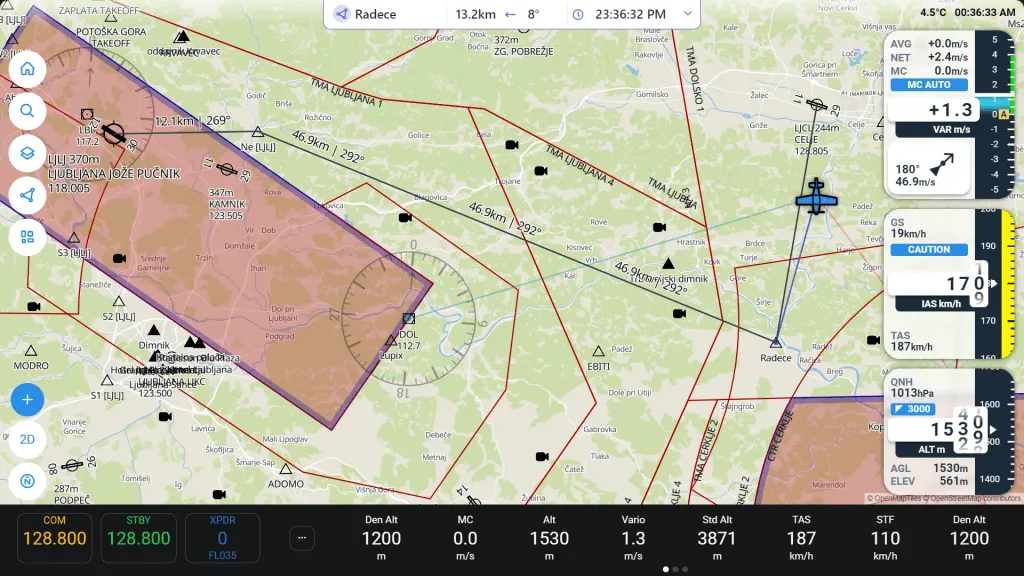
LX Academy started as a handful of articles about the things pilots ask us at shows. It is now twenty-three, and today we are publishing the biggest batch yet: seven new pieces, each written at the same desks in Celje where the instruments are designed, and each built around an interactive model you can pull apart rather than a diagram you have to take on trust.
What is new
- The airspace you cannot see is still there — classes, floors and ceilings in three different altitude references, and why a flight-level base moves with the weather while an AGL lid does not.
- The thermal assistant is drawing your last turn — what the coloured circles actually are, and what an off-centre circle costs you in metres per second.
- Who can actually see you — FLARM, Mode S, ADS-B and TCAS are four conversations on four frequencies. Switch on what you carry and read the table.
- One cable behind the panel — why instruments share two wires, what CAN does with them, and the 120 Ω rule behind most intermittent faults.
- The six-pack did not disappear, it moved — a live PFD you can fly with sliders, including what the stall speed does when you roll into 60°.
- The wing does not know how fast you are going — a wing stalls at an angle, not a speed, and the placard number is true at exactly one weight and one bank.
- The engine is talking in numbers — EGT is a mixture instrument, CHT is the limit, and a logged trend finds failures a red line never will.
Every one of them has a working model in the middle of the page. Drag the QNH and watch a TMA floor slide down toward you. Add a vario delay and see the strongest part of a thermal appear in the wrong place. Lean an engine past peak EGT and watch the cylinder head cool down. The point is not the animation — it is that the numbers behind our instruments are not secret, and a pilot who has played with them once flies differently.
Five new device guides too
Alongside the theory, the knowledge base gained five practical guides written for owners and installers: Era setup and first flight, iris EFIS installation and calibration, upgrading an LX 4000 to 7007 system to the LX 10K, how a NAVIA system fits together, and the CAN bus wiring rules that prevent the fault every avionics shop knows by heart.
All of it is free and open — no login, no email address, no marketing filter. If something you keep wondering about in the cockpit is still missing, tell us: the engineers pick the next article from what pilots ask.
Stories like this by email — firmware releases, new instruments and show dates, a few times a year.