
Traffic monitor 80
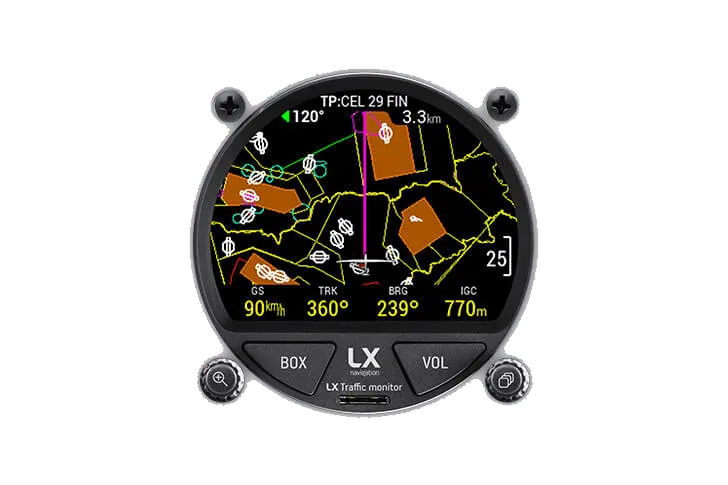
A dedicated 80 mm FLARM display with a 3.5 inch transflective screen: radar page, voice warnings and standalone turnpoint and airport navigation.
- A 3.5 inch transflective screen — a full inch more than the 57 mm
- Built on the LX 10K platform — the most capable FLARM display we make
- Spoken and drawn collision warnings, plus a track-up radar page
- Turnpoint and airport navigation at the same time, over airspace
- Traffic monitor 80
- 32 GB Micro SD card
- 40 cm connecting cable
You may also like.



Details.
A FLARM with no display in the panel is a device that knows something you do not. The Traffic monitor is what tells you. It works with every FLARM device on the market, takes its data over a standard cable from the FLARM port, and fits an 80 mm instrument cutout.
Inside it is the LX 10K platform, which is why a traffic display has a moving map and a voice at all.
Why the 80 mm
This version carries a 3.5 inch transflective display — a full inch more diagonal than its 57 mm sibling, on the same software and the same controls. Transflective means the screen gets more readable in direct sunlight rather than less. On the radar page that extra size is the difference between seeing that there is traffic and seeing where it is; on the map pages it is the difference between an airspace outline and a readable chart.
If the panel has no 80 mm hole to spare, the 57 mm model does everything this one does on a smaller screen.
Warnings first
The primary job is the warning: a collision alert, spoken and drawn, with the direction and the relative height of the other aircraft. Everything else on the instrument is secondary and can be ignored on a busy day.
The radar page shows every FLARM object, track-up. Aircraft whose pilots have enabled FLARM privacy mode appear as a plain dot rather than a full symbol — their warnings still arrive regardless. If your FLARM has an ADS-B module, non-directional transponder traffic is drawn as a red range ring: the perimeter the object could be on, rather than a bearing it is not broadcasting. Select any object and you get its climb rate, horizontal and vertical distance and ground speed.
And navigation, because the platform was already there
Two moving-map pages navigate to a turnpoint from a .cup file and to an airport from an .af file at the same time, over a map carrying turnpoints, airports and airspace. Choose an airport and the voice module reads out its runway direction and frequency. An info page shows GPS status, supply voltage and the FLARM device ID you need to register with OGN; the logbook becomes a live statistics page in flight, with take-off time, duration, maximum altitude and airspeed, and an altitude graph.
Controls and wiring
Two push-rotary knobs and two buttons, every one of them marked: PAGES to move between pages and confirm, ZOOM to zoom and to cancel, VOL for volume and brightness, BOX to hide the NavBox line. Turning a knob while pressing it steps through a long list far faster.
Every port on the back is marked too: FLARM in, FLARM out, and a 3.5 mm audio out. There is no amplifier inside, so the audio output wants an intercom, an audio panel or a powered speaker rather than a bare passive one. Installation and wiring take about fifteen minutes. In the box: the monitor, a 32 GB micro SD card and a 40 cm connecting cable.
Questions pilots ask.
What do I get for the extra 23 mm of cutout?
A 3.5 inch screen instead of 2.5. Same software, same controls — on the radar page it is the difference between seeing that there is traffic and seeing where it is.
Will it work with a FLARM that is not yours?
Yes. It takes the standard FLARM protocol from the FLARM port of any FLARM or PowerFLARM device.
Can I drive a speaker straight from it?
Not a bare passive one — there is no amplifier inside. The 3.5 mm output wants an intercom, an audio panel or a powered speaker.